
The short answer
Maggots are fly larvae. The location and the material around them are often more useful clues than colour alone.
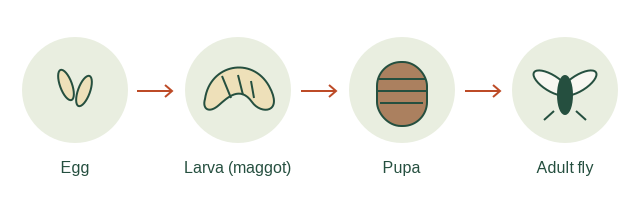
A stage in a fly’s life
In everyday household use, “maggot” means the larval stage of a fly. It is not a name for every small, pale creature that crawls. Moths and beetles also have larvae, but their identification and control can be different.
A fly develops through egg, larva, pupa and adult stages. The larva feeds and grows; the pupa is the stage in which it changes towards the adult form. Conditions and species affect how quickly that happens, so a single timetable cannot identify what you have found.
Why they appear around a home
Some household flies develop in decaying organic material. Food waste is one possibility, but the relevant material may be elsewhere. Finding larvae is a reason to look for a source, not evidence that an entire home is dirty.
Start with the setting: inside a rubbish bag, beside a pet-waste area, in a food cupboard, near a drain or emerging from a gap. Write that down before cleaning. A precise location helps you choose which possibility to investigate and avoids treating every room in the same way.
Why they may crawl away
Some fly larvae leave their feeding material as they approach pupation. This helps explain why larvae can appear on a floor even when the food source is not directly beneath them.
Follow the clues without assuming that the direction of movement proves a source. Note nearby gaps, smells, waste containers and stored foods. Do not pull apart electrical equipment or building cavities to follow an uncertain trail. A pest professional can help with inaccessible or persistent problems.
Seeing a few larvae after a clean-up is a reason to recheck the area. It is not a reliable test of whether a particular chemical “worked”.
Not every pale larva is a maggot
Pantry-moth caterpillars can be pale and may travel away from stored food. They can appear on walls or ceilings. Webbing in a dry-food packet is a different clue from larvae in wet rubbish.
Small flies around drains also require a different search. Their breeding material can be the organic build-up associated with a drain. Spraying a nearby surface does not identify that material.
Use a clear close-up and a photograph of the surrounding area. A picture can help narrow possibilities, but colour and size alone are not enough for a confident species identification. The visual guide explains what to record.
Household waste and health concerns are different
Some fly species can cause myiasis, an infestation of human tissue. That is a medical issue. The controlled use of selected larvae in clinical wound care does not make wild larvae safe to put on skin or wounds.
If larvae are on a person or in a wound, contact a healthcare professional. If they are on an animal, seek veterinary advice promptly. Do not try a bin-cleaning method or a household pesticide.
For an ordinary waste problem, start by safely removing affected material and cleaning the container. The practical removal guide keeps the focus on that job without assuming that all larvae behave alike.
Sources & further reading
Sources inform the guidance above. Product labels and local waste rules take priority for a specific product or collection service.
- University of Minnesota Extension: Flies
- University of Minnesota Extension: Pantry pests
- University of California IPM: Moth or drain flies
- CDC: About myiasis
- RSPCA: Rabbit health and flystrike
Spotted something that needs correcting? Email James with the page address and the detail.