
The short answer
Look at the body, the setting and any nearby adult insects. A single blurry picture cannot reliably identify a larva.
How to use this guide
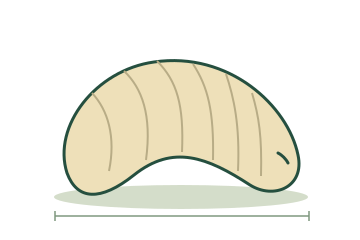
The drawings on this page are schematic illustrations, not photographs. They show broad features to look for and are not to scale. They cannot establish a species, identify a medical condition or confirm whether a treatment is appropriate.
If you found larvae on a person, a pet or a wound, seek appropriate medical or veterinary care. Do not delay that decision while trying to match the illustration. For larvae in waste or around a room, the checks below can help you describe the finding more clearly.
Features worth noticing
Common household fly larvae are often pale, soft-bodied and legless, with one end narrower than the other. Appearance varies between species and stages. A shape that broadly matches these features is a starting point, not a diagnosis.
- Look for visible legs or hairs rather than relying on colour.
- Record an approximate length without handling the larva.
- Notice whether there is one larva or a cluster.
- Photograph any adult flies or moths nearby separately.
Do not crush a specimen just to inspect it. If professional identification may be needed, ask the service how it wants photographs or a sample supplied.
The setting is part of the picture
A close-up hides useful information. Take a second, wider photograph showing the bin, cupboard, drain or floor where you found the larvae. Describe what was nearby, whether there was a smell, and whether the area was wet or dry.
Larvae beside rubbish suggest a different investigation from larvae in a sealed-food cupboard. Neither observation is proof by itself. A larva may have moved from its feeding material, and what looks like a fly larva may be another insect.
Record the date and room so that a later sighting can be compared with the first one.
Lookalikes to keep in mind
Pantry-moth larvae are caterpillars. They can be whitish or other pale shades, and may be found away from the packet they developed in. Silk webbing in stored food is a useful reason to inspect the pantry.
Drain-associated insects have their own life cycles and sources. Finding a small fly near a sink does not automatically mean that every larva in the kitchen came from that drain.
Some beetle larvae are also mistaken for maggots. Clear photographs of the whole body are more informative than a distant white speck. If the result remains uncertain, choose identification help rather than a product based on a guess.
Take a useful photograph safely
- Use good light and focus on the larva rather than the background.
- Take one close view and one showing the location.
- Place a ruler nearby only if you can do so without touching contaminated material.
- Keep the original image rather than sending only a heavily cropped copy.
- Remove personal information from the frame before sharing it.
A photograph helps someone assess visible features. It cannot reveal an inaccessible source, verify sanitation or replace an examination of a person or animal. If you are reporting an error in this guide, contact james@maggots.co.za; this inbox is not an emergency service.
Sources & further reading
Sources inform the guidance above. Product labels and local waste rules take priority for a specific product or collection service.
- University of Minnesota Extension: Flies
- University of California IPM: Flies
- University of Minnesota Extension: Pantry pests
- University of California IPM: Moth or drain flies
- CDC: About myiasis
Spotted something that needs correcting? Email James with the page address and the detail.